
By Satish Sekar © Satish Sekar (April 2nd 2020)
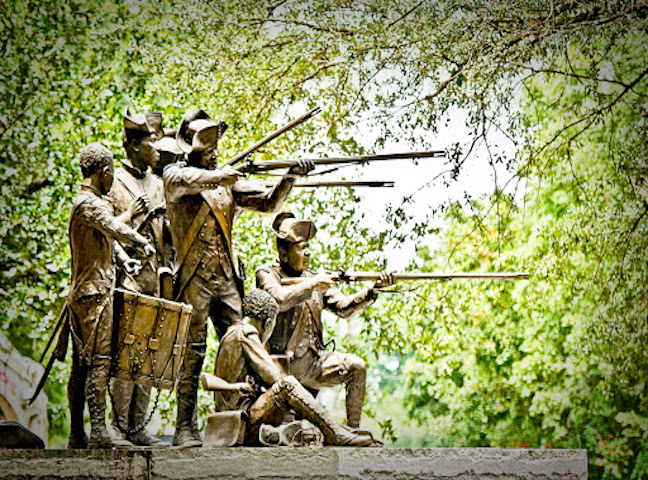
Over two centuries ago an untrained army of self-liberated slaves and their unlikely allies shook up the world. Never before had slaves with no military training taken on and defeated the three military superpowers of the time.
But their victory galled historians. Ten years before General Winter aided the great Russian commander General Mikhail Kutuzov to defeat Napoléon Bonaparte’s Grand Army, the Haitian Revolutionaries did it twice. The first significant defeat Napoléon suffered was not the Russian Campaign of 1812, it was Haiti almost a decade earlier.
And this was no insignificant campaign, it was so vital to Bonaparte, he made peace with Britain to have it conducted. Haiti (then known as Saint-Domingue) had been the jewel in France’s colonial crown. It was vital to France’s economic future. Napoléon wanted it back. It was an essential part of his strategy.
Haiti would fund his campaign for global domination. It was so important that he suspended war with Britain when William Pitt the Younger’s failure to seize Haiti ad been a costly disaster that left Britain never so vulnerable. Instead of taking advantage y attacking a vulnerable Britain, Napoléon was more concerned with regaining Haiti. He even trusted his enemy by telling his greatest enemy of his plan to restore slavery.
Kutuzov’s Scorched Earth was effective because of General Winter’s contribution. Extended supply lines and guerrilla attacks massacred Napoléon’s plans in Russia, but where was the difference? Replace General Winter with General Yellow Fever and you have the campaign fought by the self-liberated former slaves in Haiti a decade and more, earlier. But unlike Kutuzov, the Haitians did it twice!
The Haitian Revolution began in August 1791. It ended with the declaration of independence on January 1st 1804. The bitter and brutal campaign achieved the near impossible. At the top of the colonial tree were white French settlers. Below them were their offspring with black slaves or former slaves.
The mixed-race offspring saw themselves as equal to whites but above blacks. They were hated by blacks and looked down on by whites. They were too few to effect change – Vincent Ogé found that out the hard way – but they would repeat the errors under General André Rigaud. However, the arrest and deportation of Rigaud sealed the fate of Bonaparte’s Haiti campaign. The earlier deportation and starvation of Toussaint Louverture combined with Rigaud’s fate united the blacks and mixed-race, as Jean-Jacques Dessalines, Alexandre Pétion and Henri Christophe met, buried their differences and won the decisive Battle of Vertières in November 1803.
It is one of the most remarkable events in human history. It shaped the world we live in. Without it Napoléon would not have been so weak that he had to sell the Louisiana Territories to fund his future campaigns. That in turn facilitated the rapid rise of the USA to superpower status – impossible without the Haitian Revolutionaries facilitating the Louisiana Purchase
It punctured Bonaparte’s claims of invincibility. It offered the tactical blueprint Kutuzov adapted in Russia. It proved the military prowess of the black generals. It dealt a hammer blow to slavery. It prompted the end of the Trans-Atlantic Slave Trade. And Pétion’s contribution to the independence of Spanish colonies was essential. Without Pétion’s contribution of men, ships, arms and resources twice, the Liberator, Simón José Antonio de la Santísima Trinidad Bolívar y Palacios Ponte-Andrade y Blanco (better known as Simón Bolívar) would have been another in a long line of failed would be Liberators, but outside of Haiti and Venezuela few know of him. Like the Revolution he became one of the great leaders of, Pétion is scandalously under-acknowledged by history.
