The Smoking Gun of Innocence Part Nine
October 28, 2025Donna Clarke’s Greatest Run (Part One)
December 3, 2025
By Satish Sekar © Satish Sekar (October 26th 2025)
Grossly Flawed – A Narrow Window of Opportunity
In the early hours of October 11th 1995 fire swept through 62 Marigold Close on the Gurnos Estate in Merthyr Tydfil, South Wales. Diane Jones, 21, and her infant daughters, Shauna Hibberd, 2 and Sarah-Jane Hibberd, 13-months, were trapped upstairs and perished in the fire. At first it was thought to have been caused by an electrical fault – it had, in fact, been caused deliberately.
It shocked and appalled the nation, especially that community, but the investigation and prosecution would be very flawed. It was known that Donna Clarke had had an affair with Jones’ partner, Shaun Hibberd. Naturally, Jones disliked Clarke because of that, but was that a credible motive for Clarke to have set that fire and if so, did she have the opportunity to commit the terrible crime?
Means and Opportunity
Strangely, the prosecution case insisted that Clarke had found the tools needed to prise open a gap in the wooden panel nailed to the front door that had been damaged a couple of weeks before the fatal fire. After she had allegedly done so, she then threw some petrol into the house along with a lighted match or matches. She then made good her escape. Nobody saw her from the moment she left the company of Carly John and Denise Sullivan at Mark Morris’ home in Clover Road to the moment she returned some ten or fifteen minutes later.
So, according to the prosecution case, Clarke must have done everything within a maximum of 15 minutes. Was this possible? No reconstructions were ever conducted to establish that everything could have been achieved in that time period, or how long it would have taken to cause the extent of damage that had been caused to the house, which was necessary to provide a reliable estimate of wen the fire was started. That, in turn, was essential to test Clarke’s alibi..
At trial, the timings relied on by the Crown was set to some degree by the 999 call to the fire service (01.59 a.m.). It had previously been stated that the fire was set around 01.55 a.m. That would have destroyed the Crown’s case, so the goalposts were moved. Clarke’s opportunity to do everything started at 01.35-01.40. Allowing the Crown the maximum time that its case claimed that meant just a quarter of an hour as she was back by 01.50, meaning that the fire had to have been set earlier. Time had to be allowed for the fire to catch as well.
The Unknown Athlete
Clarke had to get from Mark Morris’ home in Clover Road to Marigold Close, then to her home on Clover Road and back to Morris’ home – she also had to perform various actions at the relevant locations. According to Google the distance between Morris’ home and 62 Marigold Close was 1126.5408 metres, the distance from there to Clarke’s home in Clover Road was 965.6064 metres and the distance from her home and the original address that she was with John and Sullivan at was 187 feet, which was 56.9976 metres. So, the total distance that she was alleged to have covered according to the Crown’s case at trial was 2149.1448 metres.[1]
Without allowing time to change her clothes and prise the panel open and set the fire and for the gradients involved, that meant a pace of 2.38793866667 (m/s) metres per second – not impossible, but more accurate timings should have been established through reconstructions. The only tests that were done were by Detective Sergeant Philip Jones, who provided both distance and time required to travel from both addresses in Clover Road to Marigold Close. That will be detailed soon in articles in the series Donna Clarke’s Greatest Run.
Nevertheless, Clarke was no athlete; she enjoyed a drink and consumed some recreational drugs – amphetamines too – and was not someone who kept in shape by training. In short, she was not an athlete of any calibre and while the original timings were tight but possible, this would have had to be her greatest ever run by far. The timings and what she had to achieve meant that her wish for reconstructions should have been accommodated. It still should be.
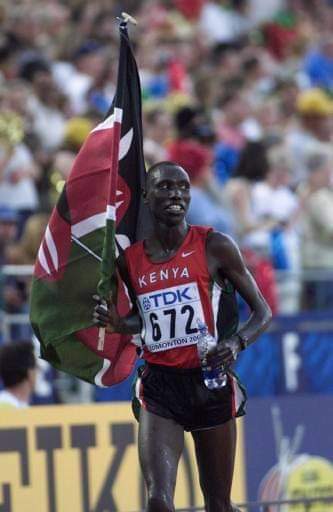
While that scenario was potentially possible a new scenario emerged in January 2000. The acceptance by the forensic scientist C. Michael Jenkins and Superintendent Jim Kerr that the accelerant used in the fire was unleaded petrol meant that the petrol bought by Hewins at Snow’s Garage could not have been the petrol used to set the fire, so the Crown’s case was now in serious trouble, as there was no case against Hewins and the case against Clarke had very serious difficulties, as she now had to obtain unleaded petrol within the time allocated for her to do everything required as well and that meant that she had to have deceived everyone into believing that she had no athletic talent when in reality she would have had to have been one of the world’s greatest ever athletes to have been guilty of setting that fire. This attracted the interest of Kenyan former athletes, especially Simon Biwott, the Organizing Secretary of Kenya’s Veteran Athletes Association (VAA).
[1] It would later emerge that the distance Clarke had to cover in that period had to have been considerably greater and that the feats Clarke had to achieve in order to be guilty meant that she would have had to have been one of the greatest athletes Britain ever produced, if not the greatest athlete ever.